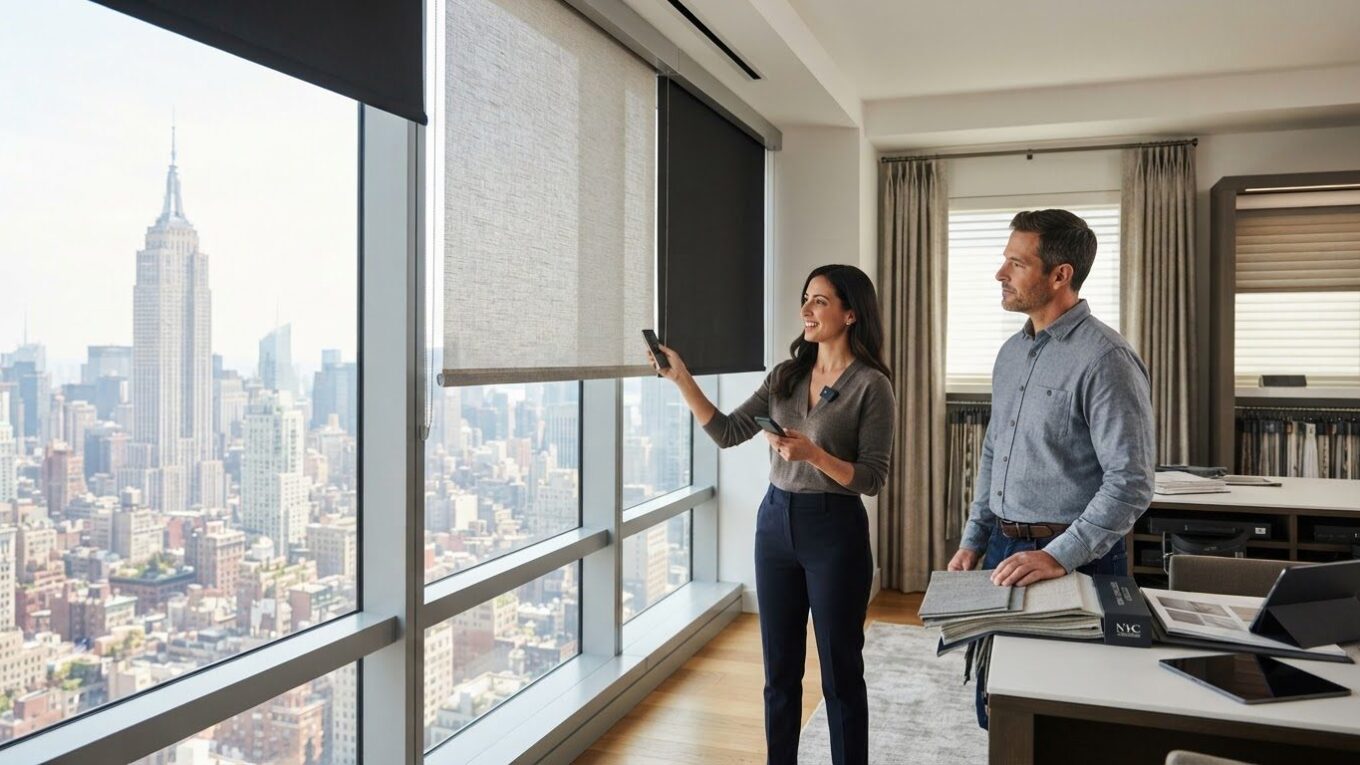
Smart, Custom Window Treatments for New York Homes
In New York, window treatments must do more than frame a view. They may need to darken a bedroom, reduce summer glare, insulate glass near a drafty façade, preserve privacy from a busy street, and operate reliably in a tightly managed apartment building.
Choosing a Motorized blinds store New York means evaluating more than fabric style. The right provider should understand custom measurements, motor specifications, building access, and the practical constraints of Manhattan, Brooklyn, Queens, the Bronx, Staten Island, Long Island, and nearby communities.
A consultation with The Blinds Source can be one way to compare materials, automation options, and installation requirements before ordering. The important question is not simply which shade looks attractive, but whether the complete system suits the window, room, power source, and smart-home environment.
Finding the Right Motorized Blinds Store in New York
A local motorized-window-treatment specialist differs from a general online retailer in several important ways. A specialist can inspect the actual opening, identify mounting limitations, demonstrate controls, and coordinate measurement with installation. Online ordering may offer convenience, but it places responsibility for dimensions, clearance, product compatibility, and troubleshooting largely on the homeowner.
An in-person showroom consultation is particularly useful when comparing:
- Fabric openness factors, from relatively transparent solar screens to privacy and blackout materials.
- Slat sizes and finishes for wood, faux-wood, and aluminum blinds.
- Headrail profiles, cassette designs, valances, and side-channel options.
- Thermal or cellular constructions for insulation around older windows.
- Motor noise, travel speed, remote controls, and charging methods.
An in-home design visit adds information a showroom cannot provide. The consultant can check inside-mount depth, window trim, mullions, handles, radiator locations, and potential obstructions. Bring photographs, approximate dimensions, and information about whether the property is a rental, condominium, co-op, or single-family home.
Confirm service territory before scheduling. Some companies focus on Manhattan; others cover the outer boroughs, Nassau and Suffolk counties, Westchester, or northern New Jersey. A provider’s installation radius can affect travel charges, service response, and whether warranty work is handled directly or through a third party.
Motorized Blinds and Shades for NYC Window Types
The best product depends on the window’s geometry and the room’s performance requirements—not merely the product category.
Large apartment windows and floor-to-ceiling glass
Motorized roller shades provide a clean profile and work well across broad expanses when divided into coordinated panels. Solar shades can reduce ultraviolet exposure and screen glare while retaining a view, but a low-openness fabric may still allow silhouettes at night when interior lights are on.
For stronger insulation, honeycomb or cellular shades trap air in internal pockets. They are useful near large glass areas, although very wide units may require careful evaluation of fabric weight and motor capacity. Drapery can add substantial light control and softness, particularly when paired with a roller shade.
Bay windows and unusual architectural openings
Bay windows require precise deductions and careful placement of brackets so adjacent shades do not collide. Roller shades, cellular shades, and Roman shades can all work, but the installer must account for angled returns, shallow frames, and unequal reveals.
Roman shades offer a tailored appearance but stack into the upper portion of the opening. That can reduce the available view or interfere with operable windows. Individual motors may be preferable when each section receives different sunlight; grouped control is more economical when the windows function as one zone.
Bedrooms requiring blackout control
For bedrooms, specify true blackout fabric or a layered treatment rather than assuming “room darkening” means complete darkness. Light gaps at the sides and top can remain even with an opaque fabric. An outside mount, blackout cassette, side channels, or overlapping drapery can reduce leakage.
Quiet motors, scheduled closing, and gradual morning opening are useful for sleep routines. Cellular blackout shades add insulation, while blackout roller shades usually provide the simplest, most compact design.
Street-facing windows
Privacy changes with lighting conditions. A sheer or solar shade may obscure daytime views from outside while preserving daylight, but the effect reverses after dark. Dual shades—typically a solar layer and an opaque roller—allow separate glare and privacy control.
Wood or faux-wood blinds provide adjustable slat angle and a more traditional appearance. Faux wood tolerates humidity better and is often easier to maintain, while real wood offers lighter weight and natural grain.
High or hard-to-reach windows
Motorization is especially valuable for transoms, stairwell windows, tall loft openings, and fixed glass above furniture. Wired motors can be appropriate during renovation, while rechargeable battery motors avoid opening walls. Solar-assisted charging may work where the window receives adequate daylight, but it should not be assumed to eliminate all maintenance.
Choosing Controls, Power, and Smart-Home Compatibility
Power planning should occur before the order is finalized. Common configurations include:
- Battery-powered motors, which simplify retrofit work but require periodic replacement.
- Rechargeable systems, which reduce disposable batteries and may need occasional charging access.
- Low-voltage wired motors, which support frequent operation and centralized control when wiring can be concealed.
- Solar-assisted systems, which can reduce charging demands in suitable exposures.
Controls range from a handheld remote to a wall switch, timer, app, or automated schedule. Grouping can close every bedroom shade together, while room-by-room zones preserve independent control. Position wall switches where users naturally enter the room, and verify whether a gateway or bridge is required for app operation.
Compatibility must be confirmed by exact motor and hub model. “Smart-home ready” does not guarantee native support for Apple Home, Google Home, Amazon Alexa, Control4, or another platform. Ask whether integration is direct, requires a third-party bridge, or depends on a professional automation controller. Also confirm whether voice commands operate individual shades, scenes, or only grouped zones.
In New York apartments, concealed wiring may require approval from a co-op board, condominium management company, or landlord. Building rules may limit drilling into masonry, window frames, or exterior walls. Cord-free operation also reduces strangulation hazards and simplifies child-safety compliance, but motors, remotes, and charging cables should still be kept out of children’s reach.
What to Expect From Measurement Through Installation
A professional consultation should document each opening rather than treating a room as one generic order. Decisions typically include:
- Width, height, depth, and inside- versus outside-mount dimensions.
- Frame squareness, sill condition, mullions, handles, and obstructions.
- Fabric opacity, color, openness factor, and stack position.
- Motor location, charging access, and control zones.
- Whether adjoining shades should align visually or operate independently.
Professional measurement is important for recessed windows, uneven historic frames, multiple adjoining openings, and oversized shades. Small errors can produce light gaps, rubbing, uneven hems, or a headrail that cannot be serviced.
Installation planning is unusually important in New York. Confirm loading-dock rules, freight-elevator reservations, insurance documentation, parking limitations, and building work-hour restrictions. Tenants may need written approval before drilling; co-op or condominium residents may need certificates of insurance and contractor registration.
At completion, the installer should secure brackets, level the headrail, set upper and lower travel limits, pair remotes, assign zones, and test every shade under load. Ask for a demonstration of manual override, charging, reset procedures, and app access. Request written information about motor warranties, fabric coverage, service-call fees, replacement batteries, and post-installation adjustments.
Budgeting for Custom Motorized Window Treatments
Custom motorized treatment pricing varies widely. As a broad planning benchmark, a small battery-powered shade may begin around $500–$1,200 installed, while larger, premium-fabric, blackout, or smart-integrated units can cost $1,500–$3,500 or more per opening. Large wired systems, motorized drapery, oversized windows, and multi-room automation may exceed those ranges.
The main cost drivers are:
- Window dimensions and the number of shades.
- Product category, fabric, lining, and finish.
- Motor type, remote, hub, wall control, and integration requirements.
- Battery, rechargeable, solar, or hardwired power.
- Professional measuring, delivery, installation, and programming.
- Difficult access, high ceilings, masonry drilling, or building coordination.
Separate product cost from measurement, installation, smart-home integration, and future service charges. Ask for an itemized estimate identifying every opening, dimensions, fabric, opacity, motor model, control method, and installation component.
Compare specifications—not just totals. One quote may use a basic roller shade with a handheld remote; another may include dual shades, rechargeable motors, a gateway, and Control4 programming. Those are not equivalent systems.
Before approving the order, ask:
- What is the expected manufacturing and installation lead time?
- What deposit is required, and when is the balance due?
- How are measurement errors or change orders handled?
- What happens if building approval delays installation?
- Which components carry separate warranty periods?
- Are batteries, service visits, and smart-home reprogramming billable?
With those details documented, a New York homeowner can judge whether the proposed treatment delivers the required darkness, privacy, comfort, appearance, and control—without confusing a low initial price with a complete installation.