Chin Enhancement in London for a More Balanced Facial Profile
A chin can have a disproportionate effect on how the entire face is perceived. Even a modest lack of projection may make the nose appear more prominent, soften the jawline or create an imbalance in side profile. Chin filler offers a temporary, non-surgical way to assess and refine those proportions.
For people researching chin filler london, the important question is not simply how much product is available, but whether the treatment suits their anatomy and goals. Hyaluronic acid (HA) filler can create projection and definition, but it must be planned in relation to the lips, nose, jaw and lower-face length.
An in-person assessment remains essential. At Define Clinic – London, treatment planning is based on facial structure, medical history and the desired degree of change rather than a standardised template. The aim should be proportionate improvement, not an identical “ideal” chin.
What Chin Filler Can Change
Chin enhancement uses injectable HA dermal filler to add carefully controlled volume beneath the skin. Depending on placement, it may:
- Increase forward projection in a weak or recessed chin.
- Improve chin shape and lower-face definition.
- Create subtle vertical elongation where the lower face appears short.
- Improve the transition between the chin and jawline.
- Soften chin dimpling, a deep mental crease or localised shadowing.
- Reduce the visual effect of minor asymmetry.
Facial balance is particularly noticeable in profile. A retruded chin can make the nose look larger or the neck-to-chin angle less defined, while a carefully projected chin may create better harmony without changing the nose or jawbone.
The chin also influences the apparent width and length of the lower third of the face. However, more volume is not automatically better. The injector must consider the patient’s sex, age, bone structure, soft-tissue thickness, facial movement and front, oblique and side views. A treatment plan designed for one face may look unnatural on another.
Filler may also soften a mental crease caused by chin muscle activity, although it is not a universal solution for every wrinkle or skin-quality concern. Where asymmetry is significant or related to the underlying skeleton, injectable treatment may offer only limited correction.
Is Chin Enhancement Right for You?
Suitable goals tend to be specific and moderate: improving side-profile balance, adding a little definition, subtly lengthening the lower face or making the chin look less recessed. Patients should be able to describe what bothers them and understand that filler provides enhancement, not a permanent structural alteration.
A consultation should include:
- Facial assessment from multiple angles and, where appropriate, clinical photography.
- Discussion of aesthetic priorities and the degree of projection sought.
- Review of previous filler, surgery, allergies, medication and relevant medical conditions.
- Assessment of skin, soft tissue, dental or skeletal factors and facial movement.
- Explanation of product choice, expected limitations, risks and aftercare.
Chin filler may be considered alongside jawline filler when the concern involves both central projection and lateral definition. In other cases, improving the chin alone may create sufficient balance. Treating the jawline without addressing a recessed chin can sometimes exaggerate an imbalance, so the areas should be evaluated together rather than selected from a menu.
A responsible plan may involve conservative initial placement followed by review. This staged approach can be useful when the patient is uncertain about the desired degree of change or when anatomy makes a large correction unsuitable.
The Treatment Experience in London
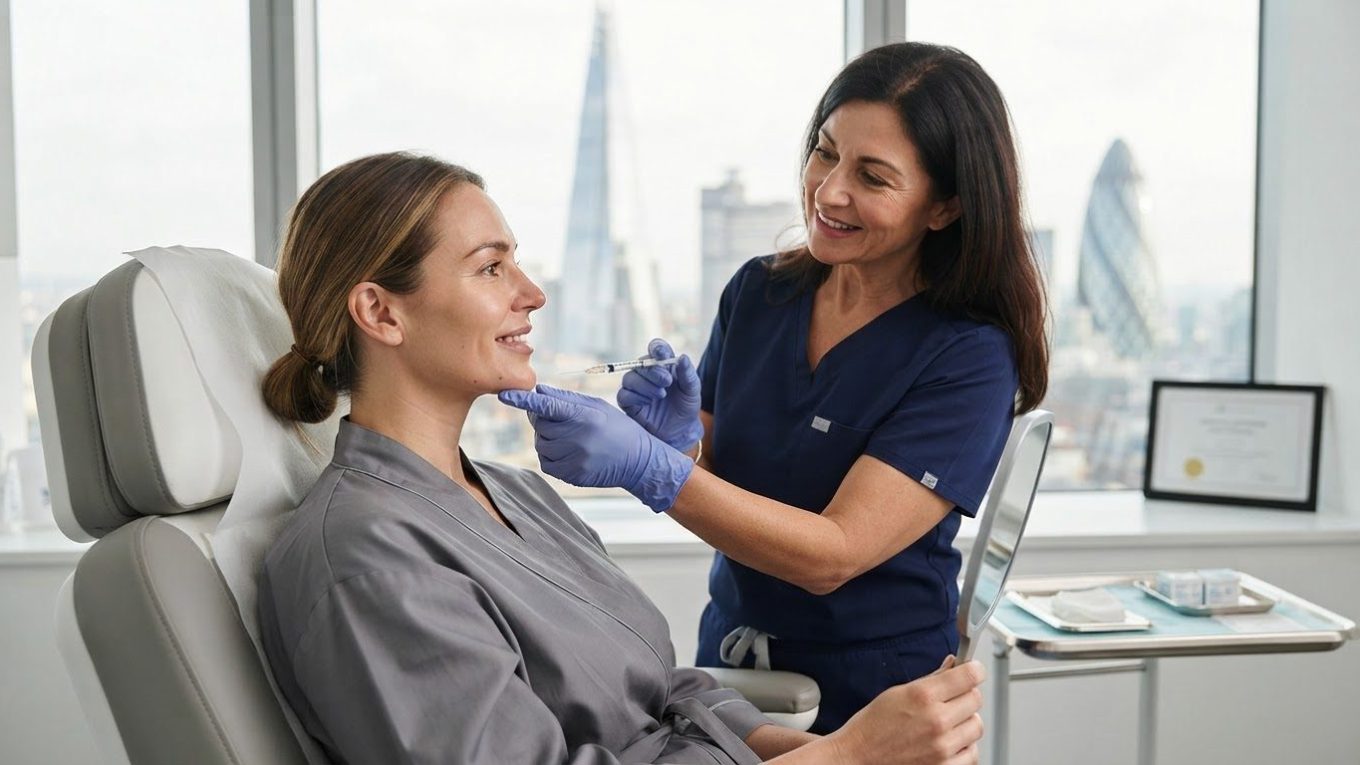
Treatment normally begins with consultation and facial planning. The practitioner may mark entry points and intended product placement while assessing the chin in a relaxed and animated state. Photographs can help document the baseline and support a later review.
The injection appointment itself typically takes under 30 minutes. Topical anaesthetic may be offered where appropriate, and many HA fillers contain lidocaine. Patients commonly describe pressure, brief stinging or tenderness rather than significant pain.
A visible improvement may be apparent immediately, although early swelling can make the chin look fuller or less symmetrical than the eventual result. Most people can return to ordinary activities straight away, but the area may feel tender and look mildly swollen or bruised.
Practical recovery advice commonly includes:
- Avoiding unnecessary pressure or massage unless specifically instructed.
- Postponing strenuous exercise for the period advised by the clinic.
- Limiting heat exposure, such as saunas, immediately after treatment.
- Following the provider’s instructions about skincare, makeup and sleeping position.
The initial settling period is usually around one week, although minor swelling or bruising can last longer in some patients. A follow-up review provides an opportunity to assess the result once the product and tissues have settled.
Results, Longevity and Potential Side Effects
HA filler is temporary. Define Clinic indicates that chin enhancement results generally last around 12–24 months, depending on the filler selected, the amount used, individual metabolism, lifestyle and treatment factors. Longevity should be treated as an estimate rather than a guarantee.
Common short-term effects include:
- Redness at injection points.
- Swelling.
- Bruising.
- Tenderness or sensitivity.
These effects usually improve over several days to a week. Maintenance should be based on the appearance, patient preference and clinical assessment—not an automatic appointment interval. Repeated treatment without reassessing the original result can lead to unnecessary volume.
Although uncommon, injectable treatments carry more serious risks, including infection, inflammatory reactions and vascular complications. Seek prompt clinical advice for escalating pain, marked skin colour change, unusual mottling, worsening swelling, fever, visual symptoms or any symptom that feels severe or unexpected. Patients should know in advance how to contact the clinic outside the appointment.
Frequently Asked Questions About Chin Filler in London
How much does chin filler cost in London?
Prices vary according to practitioner qualifications, clinic setting, product, treatment complexity and the quantity required. In London, a broad starting range of roughly £350–£700 for a single treatment is common, while more complex plans or multiple areas may cost more.
Price comparisons should establish what is included:
- Consultation and medical assessment.
- Product brand and quantity.
- Treatment and any planned review.
- Aftercare advice and access to clinical support.
A very low headline price may not represent equivalent expertise, product choice or follow-up arrangements.
How much filler is usually needed?
There is no universal one-millilitre rule. Volume depends on the chin’s projection, bone and soft-tissue anatomy, the intended change and whether the jawline or another area is also being treated.
A subtle refinement may require less product, while a more recessed chin may need a different plan or staged enhancement. The safest approach is assessment-led dosing rather than selecting a volume in advance.
Is 0.5 ml enough for chin enhancement?
It can be enough for a small refinement, mild asymmetry or an initial staged treatment, but it may not create a substantial change in a significantly recessed chin. The result also depends on filler elasticity, placement and the patient’s anatomy.
A practitioner should explain what 0.5 ml is realistically likely to achieve and whether further treatment would be appropriate after settling.
Is chin filler worth it compared with surgery?
Filler appeals to patients seeking a quick, temporary and reversible option with limited downtime. It can be useful for testing a change in projection or achieving a modest improvement without an operation.
Surgical augmentation generally offers a larger and longer-lasting structural change, but involves greater cost, recovery, procedural commitment and surgical risk. Filler cannot reproduce every outcome of an implant or sliding genioplasty, particularly where substantial skeletal advancement is required. Patients with marked recession may benefit from discussion with an appropriately qualified surgical specialist.
Will the result look obvious?
It should not if the treatment is conservatively planned and proportionate to the rest of the face. Natural-looking enhancement depends on controlled projection, appropriate product selection and reviewing the chin from front, side and oblique angles.
The intended result is usually that the face looks more balanced, rather than that other people identify a procedure. Overcorrection, excessive volume or treating the chin in isolation can produce an artificial appearance.
How do I choose a safe London clinic?
Look for a practitioner with relevant medical training, experience in facial anatomy and a clear consultation process. Ask which product will be used, whether it is appropriately authorised for the intended purpose, and how complications are managed.
Useful checks include:
- Before-and-after photographs showing comparable starting anatomy.
- Transparent discussion of risks, limitations and alternatives.
- Written aftercare and accessible follow-up arrangements.
- A genuine opportunity to decline treatment without pressure.
- Clear pricing that does not rely on discounts or exaggerated promises.
London patients may also wish to consider travel and follow-up practicality. A clinic that is easy to reach is useful if swelling, bruising or an unexpected concern requires review, but convenience should never outweigh clinical standards. The best decision is based on suitability, informed consent and a carefully individualised plan.